
Snake Avoidance Dog Training
A nightmare for every dog owner, snake bites are a tragically dangerous and costly event. If your dog is bitten by a snake you can expect to be paying in excess of $3000.00 for treatment at the vet, and there is no guarantee of survival.
What to do if your dog is bitten
You are unlikely to find the location of the bite through the dogs fur, so don’t waste your time bandaging, most often snakes will strike the face or front legs as the dog is investigating.
The best thing to do is to restrict movement and quickly get to the nearest vet without delay, the more time that goes by the less chance your dog has of survival.
Call ahead to make sure there is antivenin in stock.
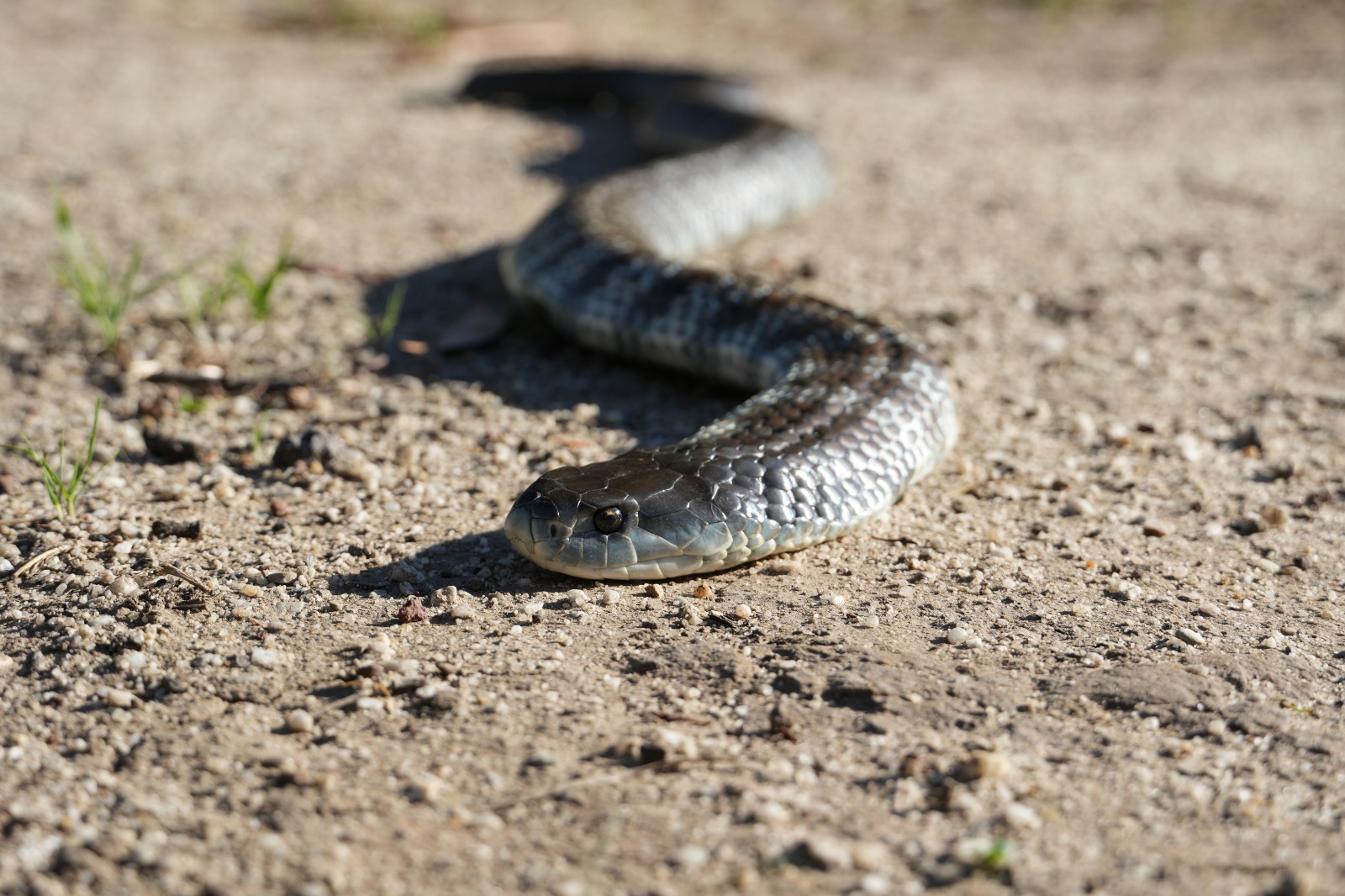
There are over 80 species of venomous snakes in Australia, although Brown snakes and Tiger snakes are the most common in Greater Melbourne. They are more toxic at the beginning of the season, which can vary according to the weather, anything from August to November.
Snakes inhabit areas close to water sources with lots of vegetation and cover, as this is where they find rodents and other small prey. So, be wary when walking along creek or river paths.
Good quality snake avoidance training teaches your dog that snakes are to be avoided at all costs as a matter of self-preservation. Teaching the dog to not only avoid when they see a snake, but also to create distance when they smell the snake as well, is an affordable proactive investment rather than having to react post-bite.
Victorian Dog Training Academy are the only organisation in Victoria that uses real live venomous snakes during the entire training process. You can’t get better than the real thing.
What Is Snake Avoidance Training, and What Results Can You Expect?
My snake avoidance training program works by creating an initial fear response to snakes in the dog’s mind.
Using an electronic collar, I am able to create an unpleasant sensation that the dog believes is caused by the snake. In dog-training terminology, this is sometimes referred to as an “act of God” consequence: the consequence appears to come directly from the environment rather than from the handler.
This is why we do not deliberately direct the dog to interact with or find the snake, and why we do not praise the dog immediately after it avoids the snake. It also means avoiding unnecessary calling or directing of the dog around the snake unless I specifically ask you to do so.
The aim is for the dog to learn independently that the sight and smell of a snake predict an unpleasant experience and that moving away from the snake makes them safe.
When learned this way, the desired response when the dog later detects a wild snake is:
Because we have tried to remain minimally involved in the learning experience, the dog should make this decision whether you are present or not.
In that respect, snake avoidance training is quite different from conventional obedience training. We are not teaching the dog a command. We are attempting to change how the dog feels about, and responds to, the snake itself.
Can a Snake-Trained Dog Still Accidentally Get Close to a Snake?
Yes. Even a dog that routinely avoids snakes can unknowingly walk very close to one.
The reason is simple:
A dog cannot avoid something it has not detected.
People do not deliberately step in front of cars, walk into posts or trip over objects. These things happen because, for whatever reason, we failed to perceive the hazard soon enough. The same principle applies to dogs.
Snake avoidance training does not give a dog supernatural ability to detect every snake. If the dog does not smell, see or otherwise perceive the snake, there is nothing for the avoidance response to act upon.
It is also important to understand that detection distance is not fixed.
Imagine a dog moving through long grass. A snake may be relatively close, but until enough scent reaches the dog’s nose, the snake moves, or the dog’s attention happens to fall on it, the dog has no information telling it that the snake is there. Then, quite suddenly, conditions change and the dog detects it.
This is why an encounter can appear to go from:
Before detection
“My dog had absolutely no idea there was a snake there.”
After detection
“My dog suddenly realised it was right beside one.”
Wind direction, terrain, vegetation, the dog’s head position, the snake’s movement and what the dog is paying attention to can all influence the exact moment at which detection occurs.
The training is designed to change what happens once the snake has been detected.

But a Dog’s Sense of Smell Is Incredible. How Can It Miss a Snake That Is Nearby?
Wind and Scent
Dogs receive airborne scent because moving air carries odour from its source.
The area in which that scent travels is commonly described as a scent cone. Its exact shape changes constantly according to wind, terrain, vegetation, temperature and other environmental conditions.
If the dog is not in the path of the snake’s airborne odour, there may simply be nothing for the dog to smell at that moment.
Snakes are also very low to the ground. Their scent may therefore be concentrated close to ground level. A dog moving quickly with its head held high can sometimes pass surprisingly close to a snake without obtaining enough scent information to recognise what is there.
Sometimes dogs virtually walk over them.
Vision
Snakes are extremely difficult to see in natural environments.
Their colouring and patterning allow them to blend extraordinarily well into grass, leaf litter and uneven terrain. A dog’s vision is also much more responsive to movement than to fine visual detail, which means a motionless snake can be especially difficult for a dog to detect.
You may actually observe this during your dog’s first training repetition. Occasionally considerable positioning is required before a dog genuinely notices the snake.
Fortunately, the greater behavioural risk is generally not simply passing near a snake unknowingly.
The major problem we are trying to prevent is the dog deliberately investigating, approaching, chasing or attacking one after it has detected it. That is where avoidance training can make an enormous difference.
When Can Snake Avoidance Training Fail or Fade?
There is a basic equation to keep in mind whenever a consequence is being used to deter behaviour:
The perceived consequence has to outweigh the dog’s desire to perform the behaviour.
If the dog wants something more than it cares about the consequence associated with obtaining it, there is no compelling reason for that dog to abstain. In some highly motivated dogs, an insufficient consequence can actually result in the dog trying harder.
What Does This Mean in Practical Snake Avoidance Training?
Most dogs that attend snake avoidance training are not obsessed with snakes.
Consider a young Labrador that has never encountered one before. It may wander towards the snake, sniff it and become interested when it moves. Its behaviour may look much the same as investigating any other unfamiliar smell or object.
The dog isn’t locked on. Its body isn’t becoming rigid. It isn’t rushing at the snake. It doesn’t have an established agenda.
If that dog’s motivation to investigate the snake could hypothetically be described as 3 out of 10, the perceived consequence might need to be 5 out of 10. It simply has to be sufficiently more important to the dog than its desire to continue approaching.
The electronic collar level required to achieve that varies enormously between dogs. My objective is not to use a predetermined number. I watch the dog.
I am looking for a stimulation level that produces an unmistakable response: the dog jumps, moves away and experiences the encounter as sufficiently stressful and memorable that it wants distance from the snake. We begin conservatively and adjust according to the individual dog’s response.
Young Labrador, no history
Curious rather than committed. A modest, carefully judged consequence is usually enough to create clear avoidance.
Six-year-old that has killed seven snakes
An entirely different behavioural problem: it may actively search, rush in, become locked on and enter a highly aroused prey-driven state.
Its motivation may be extremely powerful. Consequently, the stimulation required to interrupt that behaviour and create meaningful avoidance may be considerably higher.
There is no universal collar level because dogs vary enormously in both their motivation and their sensitivity while highly aroused. Some dogs remain physically sensitive even when in prey drive. Others become extraordinarily insensitive to physical discomfort once they are highly motivated.
This is why the dog, rather than a predetermined number on the collar, determines the level required.
Which Dogs Are More Likely to Have Their Training Fade?
The dogs I am most cautious about are dogs that really want to find, pursue or attack wildlife — and particularly dogs that already have a history of killing snakes.
Most dogs do not have that level of motivation.
Some dogs will see a kangaroo and have little interest in chasing it. Some will watch a cat walk past and remain relatively indifferent. Likewise, many of the dogs we train have no previous emotional investment in snakes. We are simply teaching them what to do if they encounter one.
The situation is different with a dog that has repeatedly hunted or killed snakes.
Hunting behaviour can be intensely biologically driven and self-reinforcing. Catching and killing prey can be profoundly rewarding to a dog that is predisposed towards it. For those dogs, continuing to pursue snakes matters to them.
And because it matters, some become extremely good at noticing the circumstances surrounding training. They may notice that:
- They are wearing an electronic collar when consequences occur.
- The training is taking place in an unusual location.
- They smelled snakes being moved through the area earlier.
- Particular people, equipment or routines predict the training exercise.
Effectively, the more motivated the dog is to preserve its ability to hunt snakes, the more likely it may be to pay attention to information that allows it to distinguish training circumstances from normal life.
Breed can sometimes alert us to increased risk — particularly where the breed and the individual’s history suggest strong predatory motivation — but breed itself is not the deciding factor. The dog’s actual behavioural history is much more important.
A Jack Russell that has killed numerous snakes, for example, immediately tells me something very different from a nine-month-old dog that has never shown much interest in pursuing wildlife.
Importantly, none of this means that a dog with a strong hunting history cannot be successfully snake trained. We have trained many dogs that had previously killed multiple snakes and subsequently stopped approaching them.
These characteristics increase the possibility that the training may fade. They do not guarantee that it will.
How Does Snake Avoidance Training Fade?
When avoidance fades, it does not necessarily disappear overnight.
A dog may initially avoid snakes very reliably for several months. Then the dog encounters snake odour or perhaps detects a snake at home. Nothing happens. The dog notices this.
Later, it may find itself slightly closer to a snake. Again, there is no consequence. That becomes another piece of information.
The dog may then begin experimenting with distance:
“I was five metres away and nothing happened.”
Then: “I was three metres away and nothing happened.”
For a dog with little desire to approach snakes, this information may be irrelevant. The dog already prefers to leave them alone.
For the highly motivated snake-hunting dog, however, repeated consequence-free encounters can gradually undermine the original avoidance response.
Each successful experiment allows the dog to move a little closer, and eventually its previous pattern of approaching, tracking or attacking snakes can begin to re-emerge.
This is why training can sometimes remain protective for a substantial period without necessarily remaining equally strong forever.
Even where some fading occurs, the training may still have provided an important period of protection and may make the dog slower or more hesitant to engage a snake, potentially giving the snake an opportunity to escape.
But once an owner sees evidence that a previously strong avoidance response is weakening, that should be taken seriously.
Refresher Training
For most dogs, I recommend refresher training approximately 12 months after their initial training.
A refresher is not simply a test to see whether the dog still remembers. In fact, around half of the dogs returning for refresher training will receive electronic stimulation again during the session. That does not necessarily mean the original training has failed.
When I conduct refresher training, I generally increase the difficulty of the setups. I am deliberately looking for any weaknesses in the dog’s response and creating opportunities to reinforce the original learning where appropriate.
There is an important reason for this. I do not want a dog repeatedly experiencing snakes during training and coming away with the new conclusion:
“I’ve now encountered lots of snakes and nothing unpleasant happens anymore.”
A refresher therefore gives us an opportunity not only to assess the avoidance response but to refresh the original association before it has an opportunity to weaken.
Some dogs will need very little additional training. Others will receive another meaningful consequence. Both can be completely normal refresher outcomes.
Dogs with a significant previous history of hunting or killing snakes may need refresher work sooner than 12 months, depending on the individual dog and what the owner is observing at home.
Young Dogs and Developmental Change
Under Victorian requirements, dogs must be over six months of age before an electronic collar can be used for this training.
There are certainly situations where a young dog genuinely needs snake avoidance training. If a six-, seven- or eight-month-old dog lives on a property where snakes are regularly seen, delaying all training may not be a sensible option.
However, when the dog’s immediate risk is lower, there can sometimes be an advantage in waiting until the dog is older. The reason is development.
Dogs can change enormously between six months of age and two or even two and a half years. Their confidence, curiosity, independence, prey drive, emotional resilience and willingness to move towards things can all change as they mature.
Imagine a seven-month-old dog that is relatively sensitive and only mildly interested in a snake. A relatively modest consequence may be enough at that age to create strong avoidance.
Two years later, however, that same dog may be a much more confident and motivated individual. It has not merely grown physically. Its perception of the world — including what it finds rewarding, threatening or worth pursuing — may have changed.
That means the experience that carried enormous significance at seven months may no longer carry quite the same weight for the mature dog.
This does not mean that young dogs cannot be successfully trained, nor does it mean that avoidance established in adolescence will necessarily disappear. Many young dogs retain their training extremely well.
It simply means that owners of younger dogs need to understand that development itself can alter the balance between motivation and consequence, and refresher training as the dog matures may therefore be especially important.
Protecting Dogs Whose Avoidance May Fade
For dogs considered at greater risk, I ask owners to monitor behaviour closely rather than simply assume that one training session has permanently solved the problem.
Depending on the dog’s history and what I observe during training, I may recommend a refresher within approximately six months, or sooner if there is evidence that the dog’s avoidance is weakening.
For dogs with particularly persistent snake-hunting behaviour, I may also recommend that the dog wears a dummy electronic collar through the warmer months.
The purpose of the dummy collar is not to stimulate the dog. It is to prevent a highly observant dog from learning that the physical presence or absence of the training collar predicts whether approaching a snake can have consequences.
Regular refresher training should then be undertaken as appropriate.
Why Does My Dog Investigate Places Where a Live Snake Has Left Residual Odour?
This is generally completely irrelevant to whether the avoidance training has worked.
Dogs possess an extraordinary ability to gather information through smell, including information about the relative intensity and direction of an odour.
Odour is not used only for locating prey. Animals also use scent information to determine where another animal has been, where it went and whether getting closer to it is safe.
Imagine a wild canid encountering the scent of a much larger potentially dangerous animal. Knowing where that animal travelled can be extremely useful precisely because the canid does not want to unexpectedly meet it.
The same principle matters in snake avoidance. We have deliberately made snake odour important to the dog.
I therefore expect a trained dog to sometimes investigate residual odour from a snake that is no longer physically at that location. That does not concern me.
The important distinction is what the dog does with the information. Investigating residual odour is not the same thing as tracking the odour until the dog reaches a snake.
If the dog checks an area where a snake has been but does not use that odour trail to deliberately close distance on the animal, the behaviour is not evidence that the training has failed.
Testing Your Dog with a Dead Snake
Dead snakes are a different issue from residual odour left behind by a living snake.
I personally prefer to concentrate snake avoidance training on live snakes.
A dead animal is not behaviourally identical to a living one, and its scent changes after death. For that reason, a dog’s response to a dead snake should not automatically be treated as proof that its avoidance of living snakes has failed.
A trained dog may approach and sniff a dead snake.
If an owner nevertheless chooses to expose their dog to a dead snake, I strongly recommend that they do not treat it as a casual test in which the dog is simply allowed to approach and investigate without consequence.
For dogs that already have an electronic collar, the collar should be on the dog so the established avoidance response can be extended to that different presentation if necessary. This may help the dog generalise the avoidance response to a snake that smells considerably different from the live snakes encountered during formal training.
However, I do not consider dead-snake testing necessary for most dogs, and I do not recommend owners handle or manipulate freshly killed snakes themselves. A dead or apparently dead venomous snake should still be treated as potentially dangerous.
For most dogs, professionally conducted training using live snakes remains my preferred approach.
Dogs That Have Previously Been Trained with an Electronic Collar
Previous electronic-collar experience requires special consideration.
Unfortunately, one of the most common mistakes people make when introducing an electronic collar is failing to prevent the dog from becoming collar-wise.
The pattern is simple:
- The owner puts the collar on.
- Commands are enforced while the collar is being worn.
- The collar comes off.
- The consequences disappear.
Dogs are extremely capable of noticing patterns like this. Eventually, instead of learning:
“I must perform this behaviour regardless of circumstances.”
the dog learns:
“I must perform this behaviour when this collar is on.”
That is what trainers mean when they describe a dog as collar-wise.
The behavioural difference can be dramatic. Some dogs appear significantly more inhibited, compliant or prepared to listen whenever the collar is present, while becoming much more expressive and opportunistic when it is removed.
Owners will frequently tell me that their dog is not collar-wise. In my experience, when I observe the dog closely, I can see evidence of collar awareness in the great majority of dogs whose previous collar training has been structured this way.
Why Does This Matter for Snake Avoidance?
Because the dog already understands the rule.
If a collar-wise dog attends snake avoidance training, experiences electronic stimulation around a snake and then goes home without the collar, it may simply categorise snake avoidance alongside everything else it has previously learned: “This is something I cannot do while that collar is on.” Yet those dogs may still badly need snake avoidance training.
The practical solution is management.
For dogs with significant collar awareness, I recommend that the collar become a normal part of the dog’s life throughout snake season — approximately from the first warm weeks of August until the last warm weeks of May, depending on local conditions.
The dog does not need to be receiving stimulation throughout that period.
The purpose is to prevent the dog from having an obvious physical cue telling it:
“Today there can be consequences.” or “Today there cannot.”
For these dogs, maintaining ambiguity about the collar, monitoring behaviour during snake season and conducting appropriate refresher training gives us the best opportunity to preserve the avoidance response.
Dogs & Snakes — Frequently Asked Questions
Did My Dog Know the Snake Was There When They Walked Past It?
If your dog showed no reaction at all — no change in body language, hesitation, alertness or behaviour — then most likely, no.
When a dog genuinely detects something noteworthy, we ordinarily see some behavioural acknowledgement, even if the dog subsequently chooses to ignore it.
What Does It Look Like When a Dog Notices a Snake or Another Animal?
You may see:
- Stopping
- Stiffening
- Becoming suddenly alert
- Orienting towards the animal
- Changing direction
- Approaching
- Moving away
- Deliberately disengaging
The exact response varies between dogs.
Why Didn’t My Dog Notice the Snake?
There are several ordinary explanations:
- The snake’s airborne scent may not have been reaching the dog.
- The snake may have been stationary and visually concealed.
- The dog’s head or attention may have been directed elsewhere.
The important point is that detection depends on circumstances. A dog’s senses may be extremely capable without being infallible.
Doesn’t My Dog Have an Exceptional Sense of Smell?
Yes, but an exceptional sensory system still needs access to the relevant information.
Wind direction, terrain, scent movement, the dog’s head position and what the dog is concentrating on can all affect whether the snake is detected.
Does a Lack of Reaction Mean My Dog Was Calm and Successfully Ignored the Snake?
Not necessarily. There is an important difference between:
“I noticed it and chose not to approach it.”
and “I never knew it was there.”
Avoidance training can only operate on a snake the dog has perceived.
Can I Rely on My Dog to Automatically Detect Every Snake?
No.
Snake avoidance training should never be interpreted as giving a dog perfect snake-detection ability.
Its purpose is to make the dog considerably safer by changing what it does when it detects a snake — particularly by replacing investigation, pursuit or attack with the desire to create distance.
Thank you for taking the time to familiarise yourself with this subject, and I hope you enjoy your day with us.
Daniel